xToDo
From Your X Collections to Clear Actions
My Role
Product Design, UX Research
Problem Insight
“We are drowning in information while starving for knowledge.”
— John Naisbitt, Author of Megatrends
Every bookmark hides a simple wish for self-improvement—a skill to learn, an article to read, a tool to try. But 'save and forget': valuable content gets stored, then buried in the digital graveyard.
The problem: bookmark folders are information 'graveyards,' not action 'starting points.'
xToDo solves this universal pain point: making bookmarks truly serve learning and growth.
The endpoint of bookmarking isn't more bookmarks—it's learning by doing, improving through action.
Product Definition
xToDo focuses on one thing: transforming X bookmarks into actionable tasks.
Competitor Comparison
| Pocket / Readwise | xToDo | |
|---|---|---|
| Core Function | Save content | Content + intent analysis |
| Organization Method | Tag-based sorting | Auto-extract goals |
| Follow-up Action | Read later | Generate action steps |
| Product Positioning | Content management tool | Learning action tool |
Pocket solves 'saving,' Readwise solves 'reviewing,' xToDo solves 'doing'—transforming bookmarks into executable learning paths.
Core Concept
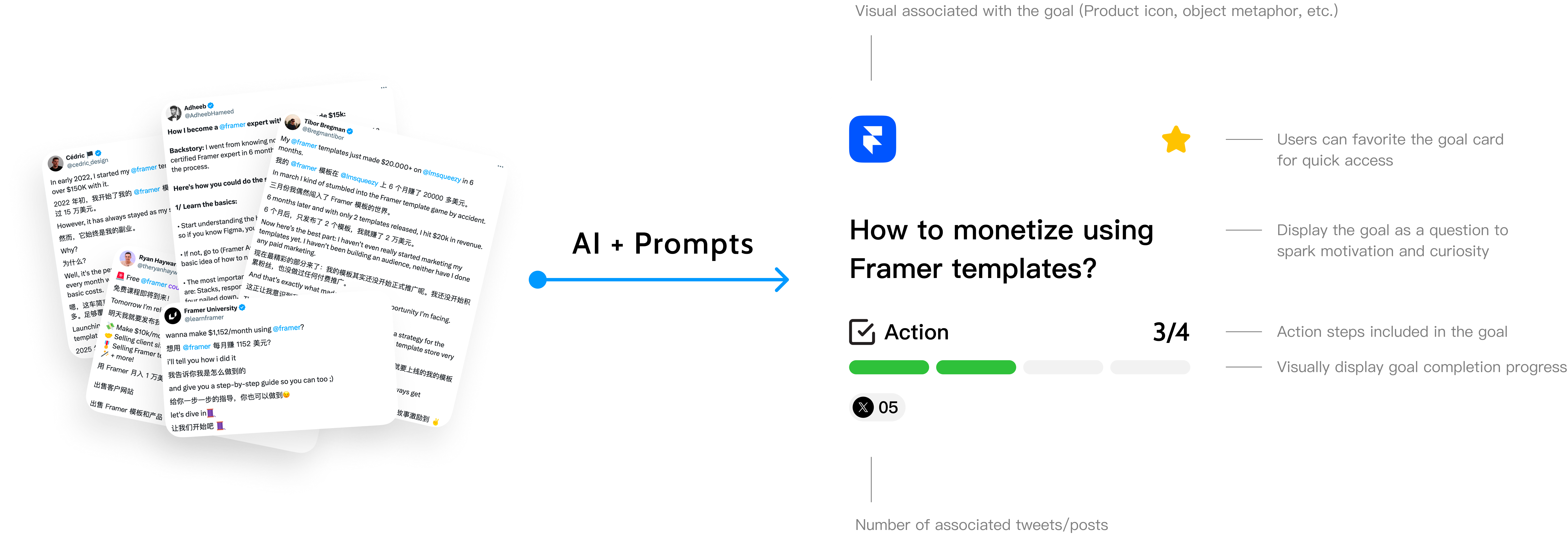
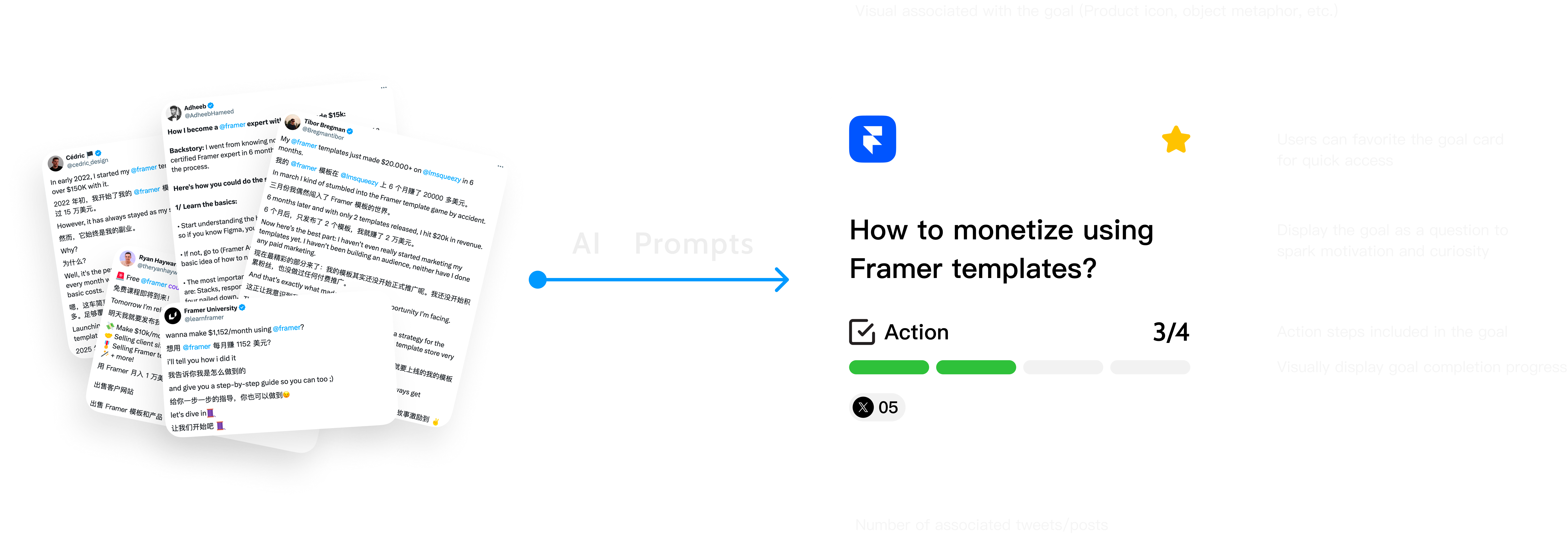
AI analyzes your scattered bookmarks and transforms them into structured goals with actionable steps.
User Flow
30-Second Authorization
One-click X account authorization, no manual data export needed. System automatically gains bookmark access.
Immediate Analysis
After authorization, AI begins analyzing bookmark content in the background. No waiting—users can browse generated goals immediately.
Progressive Results
Analysis results update in real-time. High-value goals identified first are displayed first, avoiding the 'wait until complete' feeling.
Take Action
Click any goal to view specific steps. Each step links back to original tweets for deeper learning.
Core Features
Smart Goal Extraction
User bookmarked 25 Figma tweets—from plugin recommendations to design system cases. xToDo identifies the learning intent: 'Master Figma Auto Layout,' generating 4 progressive steps, each linking 3-5 related tweets.
- Design decision: Prioritize 'skill learning' goals over vague 'understand Figma'
- Challenge: How to distinguish 'casual saves' from 'genuine learning intent'? Solution: Judge by bookmark frequency and content depth
- Result: Users report goals 'immediately actionable,' eliminating confusion
Zero-Wait Design
Initial design: 'Show all results after import completes.' Testing revealed users anxiously watching progress bars. Switched to streaming: display each goal as identified, creating 'continuous progress' perception.
Design decision: Sacrifice perfect ordering for immediate feedback. Users care more about 'seeing value quickly' than 'perfect result sequence.'
Card-Based Goal Management
Abandoned traditional lists for card layout. Each card shows: goal title, completion rate, next action, related tweet count. Users can drag to reorder and mark priority.
Business & Technical Strategy
Layered AI Architecture
Lightweight models handle classification tasks (fast response, low cost), reasoning models handle goal generation (high quality, deep understanding). This hybrid strategy keeps single-analysis costs reasonable while ensuring user experience, laying foundation for scale.
Freemium Pricing Strategy
Free tier: 3 AI-generated goals per month to experience core value. Pro ($4.99/month): unlimited goals, advanced classification, progress tracking. Expected 5-8% conversion rate—benchmarked against similar tools (Readwise 7%, Notion AI 6%). Key: let free users 'taste value but want more.'
Reflection
This project made me rethink 'AI products' fundamentally: not about applying the latest models, but using AI to solve real problems. xToDo focuses on one scenario—X bookmark transformation—and goes deep.
Biggest challenge: finding the right 'goal granularity' balance. Too broad ('learn design') offers no guidance, too specific ('read this article') loses integration value. Through multiple testing rounds: goals should be '1-2 week achievable skill points,' steps should be '30-minute executable actions.'
If continuing iteration: 1) Explore 'goal dependencies' (need to learn B before A) 2) Multi-platform integration (Reddit, Medium saved content) 3) Community features (share your learning paths).